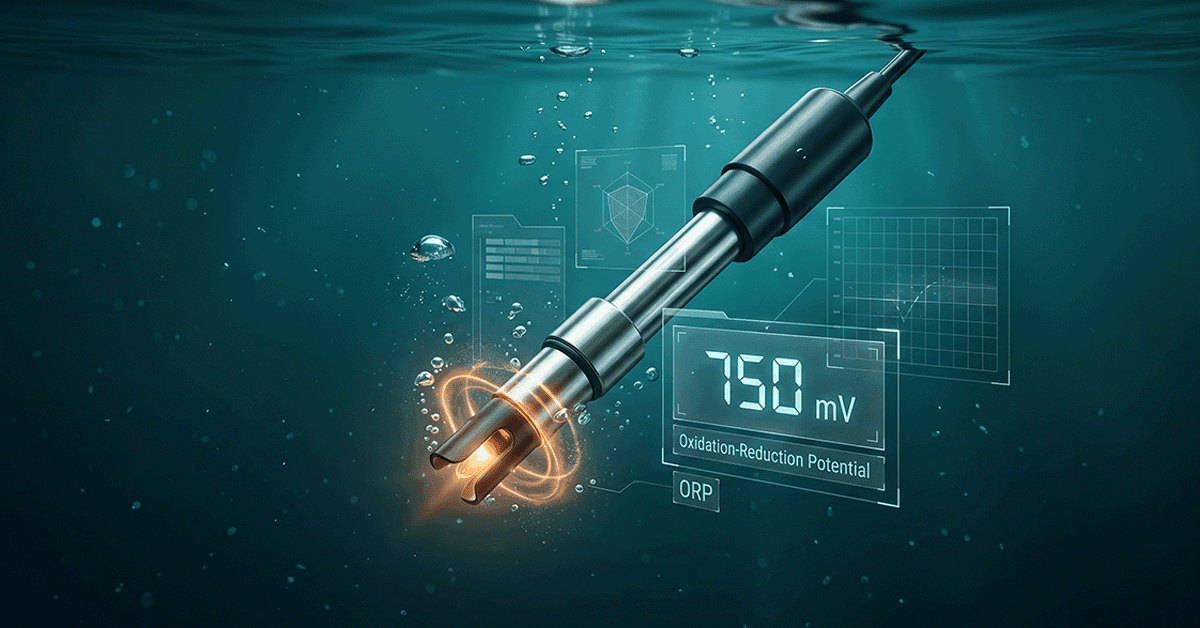
Oxidation-Reduction Potential (ORP) is a measurement in millivolts (mV) that determines the active sanitizing power of your pool water. While standard tests measure the physical quantity of chlorine (PPM), ORP measures how effectively that chlorine is actively destroying bacteria and organic waste.
When I first started managing water chemistry, I would stare at my test kit showing perfect chlorine levels, yet the water looked dull and my digital sensors flashed warnings. It was frustrating until I learned the difference between having chlorine in the water and having active chlorine doing its job. That is exactly where ORP comes into play. If you have ever wondered why your pool is struggling despite adding plenty of chemicals, understanding ORP will solve that confusion once and for all.
What is ORP and Why Does It Matter for My Pool?
ORP stands for Oxidation-Reduction Potential. It is a measurement, expressed in millivolts (mV), that tells me the electrical potential generated by active oxidizers in the water. While standard tests measure the physical amount of a chemical, ORP measures the real-time activity and effectiveness of that chemical.
When oxidizers like chlorine are added to pool water, they steal electrons from contaminants, destroying bacteria and algae. The ORP sensor detects this electron exchange. A high positive voltage reading indicates rapid and aggressive oxidation, meaning the water is actively neutralizing threats. I rely on ORP because it gives me a direct answer to the most important question: is the water safe to swim in right now?
ORP measures the active oxidizing power of your pool water in millivolts. It is the most reliable indicator of real-time water safety and sanitation effectiveness, telling you how aggressively contaminants are being destroyed.
How Does ORP Differ from Chlorine PPM?
The biggest mistake I see pool owners make is assuming that ORP and Chlorine PPM are the exact same thing. They are entirely different measurements that complement each other.
Chlorine PPM (Parts Per Million) measures the quantity or mass of the sanitizer in the water. If I add two pounds of shock to the pool, the PPM goes up. However, having a high quantity of chlorine does not guarantee that the chlorine is actively working.
On the other hand, ORP measures the activity or effectiveness of that chlorine. You can have a high PPM reading but a low ORP reading if the chlorine is inhibited by other factors. To help make sense of this relationship, I built an ORP to PPM Calculator that estimates chlorine levels based on ORP and pH readings. I use PPM to know how much chemical to add, but I use ORP to know if those chemicals are actually keeping the water clean.
PPM measures the physical quantity of chlorine present, while ORP measures how effectively that chlorine is actively sanitizing the water. You need both metrics to properly manage a pool.
What Are the Key Factors Influencing ORP Levels?
Whenever I encounter an ORP reading that does not match my expectations, I immediately look at three main variables that suppress oxidation activity even when chlorine levels are high.
pH Level
The pH level is the primary driver of chlorine efficacy. When I lower the pH toward 7.2, the chlorine forms Hypochlorous Acid (HOCl), which is an extremely potent oxidizer. As the pH rises toward 8.0, the chlorine converts into Hypochlorite Ion (OCl⁻), which is incredibly sluggish. This shift causes the ORP to plummet rapidly.
Cyanuric Acid (CYA)
We add Cyanuric Acid to outdoor pools to protect the chlorine from being destroyed by the sun. However, this protection comes at a cost. CYA binds tightly to the chlorine, putting it in a dormant state. I have found that a CYA level over 50 ppm significantly lowers the ORP because the chlorine is no longer free to rapidly oxidize contaminants.
Temperature
Water temperature affects both molecular activity and the physical sensor readings. While heat can temporarily increase chemical reaction speeds, it also degrades chlorine much faster, causing ORP fluctuations throughout the day.
| Factor | Impact on ORP | My Recommendation |
|---|---|---|
| High pH (> 7.6) | Significantly lowers ORP | Keep pH strictly between 7.2 and 7.4 |
| High CYA (> 50 ppm) | Suppresses oxidation speed | Dilute pool water if CYA exceeds 50 ppm |
| High Temperature | Accelerates chlorine loss | Monitor closely and increase sanitizer feed rate |
ORP is highly sensitive to pH, Cyanuric Acid, and temperature. High pH and high CYA bind or weaken chlorine, causing low ORP readings regardless of how much chlorine you have physically added to the water.
Why Is My ORP Low But Chlorine High?
I get asked this question constantly. You test the water and see a robust 3.0 PPM of Free Chlorine, but your digital ORP sensor is stubbornly stuck at 550 mV. If you experience this, adding more chlorine will not fix the issue.
This scenario is known as chlorine lock. The chlorine is physically present in the water, but it is asleep. It is being inhibited by either a high pH level that has converted it into a weak ion, or a high Cyanuric Acid level that is holding onto it too tightly. I always tell operators to stop dumping shock into the pool when this happens and instead focus on rebalancing the water mechanics.
A high chlorine reading with a low ORP indicates chlorine lock. The sanitizer is present but unable to actively oxidize contaminants due to chemical imbalances like elevated pH or excessive Cyanuric Acid.
How Do I Raise ORP in My Pool or Hot Tub Quickly?
When I need to quickly elevate my ORP back to a safe operating range, I follow a systematic approach rather than just guessing. Here is exactly how I tackle the problem.
Step 1: Lower the pH
The fastest and most effective way I raise ORP is by adding muriatic acid or sodium bisulfate to lower the pH to around 7.2. Lowering the pH by just 0.4 points can instantly cause a massive spike in ORP simply by activating the chlorine that is already sitting dormant in the water.
Step 2: Dilute High CYA
If my tests show Cyanuric Acid levels above 50 ppm, no amount of chemical tweaking will permanently fix the sluggish ORP. The only method I trust to reduce CYA is to partially drain the pool and refill it with fresh, balanced water.
Step 3: Use Non-Chlorine Shock
Sometimes the water is bogged down by combined chlorines and organic waste that the regular sanitizer cannot clear. In these cases, I apply Potassium Monopersulfate (MPS). This non-chlorine shock burns off the waste and raises the ORP without unnecessarily spiking my Free Chlorine PPM.
To rapidly increase ORP, first lower the pH to activate dormant chlorine. If CYA is too high, dilute the water, and use a non-chlorine shock to destroy organic waste holding the ORP down.
What Is the Ideal ORP for a Saltwater Pool?
Whether I am managing a traditional chlorine pool or a saltwater pool, the standard industry target remains the same. I aim to maintain the ORP between 650 mV and 750 mV.
A saltwater generator produces pure chlorine gas right at the cell, which is highly active. However, once that chlorine circulates into the main pool body, it faces the exact same environmental factors as liquid chlorine. By keeping the ORP above 650 mV, I ensure that the water can achieve rapid kill times against pathogens like E. coli, providing a safe swimming environment. If you want to learn more about the specifics of saltwater dosing, check out my guide on Salt Pool PPM.
The ideal ORP for saltwater pools is 650 mV to 750 mV. This range guarantees that the chlorine produced by the salt cell is actively neutralizing bacteria and keeping the water safe.
Can I Use ORP Instead of Testing for PPM?
I strongly advise against abandoning your PPM testing. ORP and PPM are two halves of the whole picture.
While I use ORP to automate my chemical feeders and confirm the real-time safety of the water, health departments strictly regulate pools based on chemical concentration. I must manually verify my Free Chlorine with a DPD test kit to ensure the actual physical quantity of sanitizer falls within legal limits. You cannot calculate the physical mass of a chemical required to dose a pool using a millivolt reading alone. If you need to convert readings, you can also explore my What is PPM guide to understand the math better.
ORP cannot replace PPM testing. ORP monitors activity for safety and automation, while PPM testing is required to ensure you meet legal chemical concentration limits and know exact dosing amounts.
How Often Should I Calibrate My ORP Sensor?
A dirty sensor will give me false low readings, causing my automation system to overdose the pool with acid or chlorine. I make it a habit to physically clean the ORP probe once a month using a soft brush to remove scale build-up and body oils.
Beyond cleaning, I calibrate the sensor every 3 to 6 months. I use a standardized calibration solution, typically rated for 470 mV or 650 mV, to reset the baseline and ensure the controller is making accurate decisions based on true water conditions.
Clean your ORP sensors monthly to prevent false readings caused by scale and oils, and calibrate them with a standard solution every 3 to 6 months for sustained accuracy.
Frequently Asked Questions
Does high ORP always mean high chlorine?
Not necessarily. While adding chlorine increases ORP, I have seen perfectly clean, well-balanced pools achieve a high ORP of 750 mV with only 1.5 PPM of chlorine. Conversely, a pool with 5.0 PPM of chlorine can have a low ORP if the pH is hovering around 8.0. The activity level defines the ORP, not just the raw amount of chemical.
What should ORP be in a hot tub?
I strictly maintain hot tub ORP between 700 mV and 750 mV. Because hot tubs run at high temperatures (over 100°F), bacteria breed exceptionally fast. If I let the ORP drop below 650 mV, the water can become unsafe in a matter of hours. I always shock the spa if the reading dips too low.
Is ORP used for drinking water?
Yes. The World Health Organization dictates that municipal water systems maintain a minimum ORP of 650 mV. I find this standard fascinating because it proves that hitting that specific voltage guarantees viral and bacterial destruction in seconds, whether it is a swimming pool or the water coming out of your kitchen sink.
Now that you understand how ORP impacts your water sanitation, use my verified calculators to interpret your real-time chemistry metrics accurately.