PPM to Grams
Calculate the weight in grams from a PPM concentration.
Grams (g)
Methodology & Formulas
Converting Parts Per Million (PPM) to grams usually trips people up because PPM isn't a strict unit of mass, it's a ratio. One part in a million parts. To find the actual physical weight in grams, you have to know what you're measuring and how much of it you have. The math changes depending on whether you're dealing with a pile of dirt, a tank of solvent, or a volume of gas.
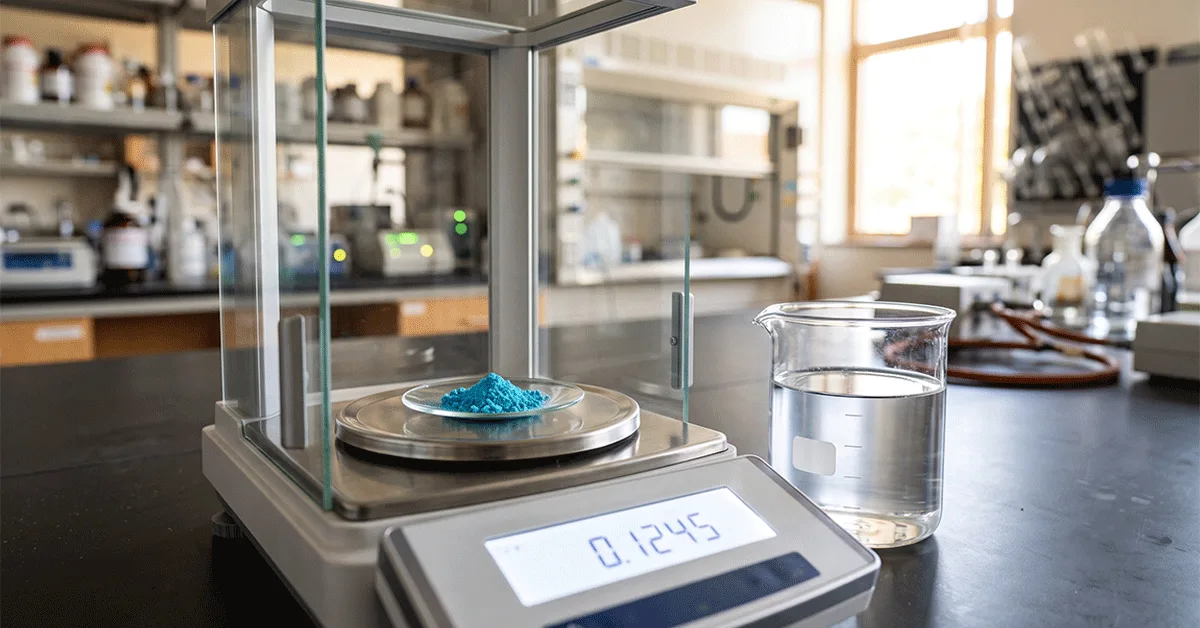
1. Solid Materials (Weight-to-Weight)
Solids are the easiest. When you're working with dry powder or soil, 1 PPM is exactly 1 milligram of substance per 1 kilogram of total material (1 mg/kg). You just take your PPM, multiply it by your total kilograms to get milligrams, and divide by 1,000 to get grams.
| Concentration (PPM) | Total Weight (kg) | Calculated Mass (g) |
|---|---|---|
| 1,000 PPM | 5 kg | 5.00 g |
| 10 PPM | 2 kg | 0.02 g |
| 500 PPM | 10 kg | 5.00 g |
The Solid Conversion Formula
2. Liquid Solutions (Aqueous & High Density)
Liquids get tricky because you have to account for density. It's common to assume 1 PPM always equals 1 mg/L. That works fine for pure water since water weighs exactly 1 kg per liter. But if you're dealing with chemical solvents, oils, or heavy brine, that assumption breaks down.
To get the actual mass from a liquid volume, you multiply the volume in liters by the liquid's specific gravity (density in kg/L) to find out how heavy the carrier fluid actually is. From there, you just run the standard solid conversion math.
The Density-Compensated Liquid Formula
3. Gases (Volumetric PPM to Mass)
Gas calculations are the most complicated because gases compress and expand with temperature and pressure changes. If a sensor gives you a reading in volumetric parts per million (PPMv), you can't jump straight to grams. You first need to figure out the gas's mass per cubic meter using its Molecular Weight (MW).
We use the standard environmental testing state of 25°C at 1 atm, where one mole of any ideal gas takes up exactly 24.45 Liters. First, you convert the PPMv to milligrams per cubic meter ($mg/m^3$). Then you multiply that concentration by the total volume of air you're measuring.
- Step A: Convert PPMv to concentration using the gas molecular weight divided by 24.45.
- Step B: Multiply the resulting $mg/m^3$ by the total volume in cubic meters.
- Step C: Divide by 1,000 to drop down to grams.
Step A: Convert to Mass Concentration
Step B: Calculate Total Grams
Why Context Matters
People often look for a straight answer to "what is 10 ppm in grams," but the math doesn't work without scale. 10 PPM of contamination in a 1,000 kg shipment of soil means you have 10 grams of absolute contaminant. That same 10 PPM in a tiny 1 kg sample is just 0.01 grams. The total mass is the only thing that anchors the ratio to a physical weight.
The same goes for trying to convert PPM directly to mg. 1 PPM is not 1 mg. It's 1 mg per kilogram of mass. If you're trying to work backward from a known physical mass to figure out your concentration, you can use our Grams to PPM Calculator instead.
References
- NIOSH Pocket Guide to Chemical Hazards
- Wikipedia - Parts-per notation
- IUPAC - International Union of Pure and Applied Chemistry
- ASTM Standards
Frequently Asked Questions
How do I convert PPM to grams?
What is the formula to calculate grams from PPM in water?
Can I use this PPM to grams calculator for gases?
Why do I need to divide by 1,000 when converting PPM to grams?
Why does the gas calculator assume 25°C?
Is this PPM to grams conversion accurate?
Can I use this for soil analysis?
What is the difference between PPM and mg/L?
Can I convert grams back to PPM?
Who uses this tool?

Lead Developer & Technical Editor
Ensuring every tool adheres to ASTM/IUPAC standards. Committed to providing precise, transparent, and verifiable engineering resources.
View Full ProfileScientific Accuracy
Formulas and logic verified against IUPAC and ASTM standards. Maintained and tested by technical editors.
View Editorial PolicyBookmark this tool for instant access. 100% free, verified accuracy, and ad-free experience.