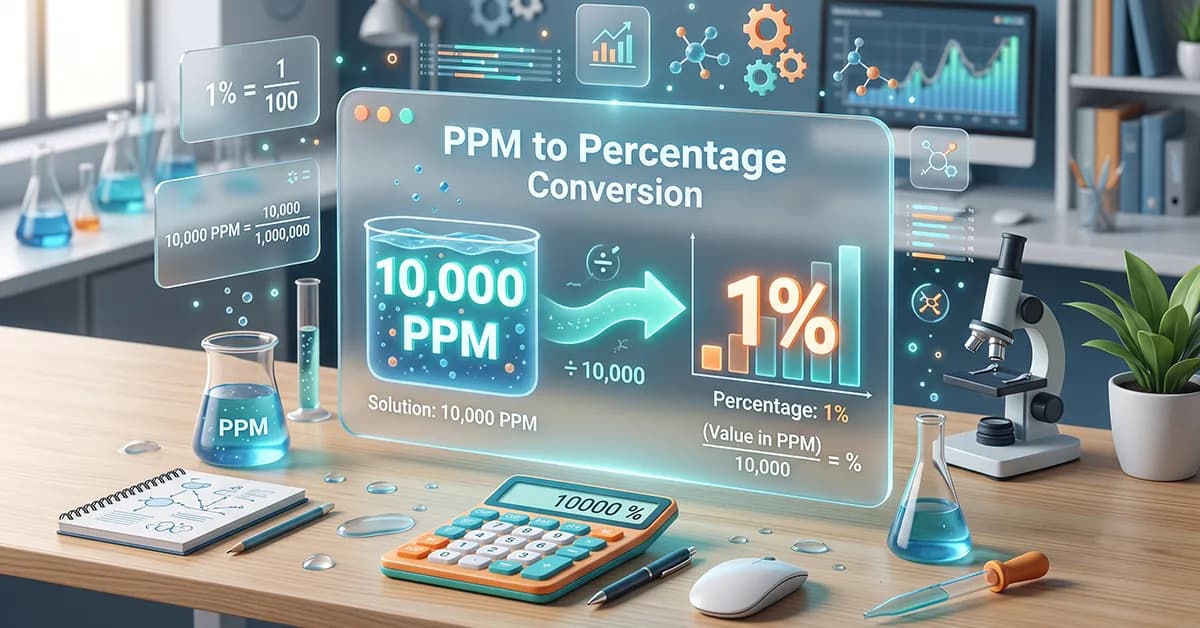
To convert PPM to percent, you simply divide the PPM value by 10,000. This straightforward mathematical division works because one percent always equates to exactly 10,000 parts per million.
In my years of working with environmental chemistry and water treatment metrics, translating exceptionally small numbers into recognizable percentages can get remarkably confusing. Whether you are dealing with trace minerals, hydroponic nutrients, or industrial air quality, I rely on a straightforward math trick to transition seamlessly between PPM and percent without ever misplacing my decimal points. Below, I will walk you through the exact formula, the science behind it, and practical industry examples.
- 100,000 PPM = 10%
- 10,000 PPM = 1%
- 1,000 PPM = 0.1%
- 100 PPM = 0.01%
- 10 PPM = 0.001%
What is the Exact PPM to Percentage Formula?
The logic driving the conversion formula is rooted in basic magnitude scaling. By definition, "Percent" literally translates to "parts per hundred" (1 / 100). Conversely, "PPM" translates to "parts per million" (1 / 1,000,000).
Since one million is exactly 10,000 times larger than one hundred (1,000,000 ÷ 100 = 10,000), you must bridge that gap of 10,000 to move from the PPM scale to the percentage scale. Therefore, you just divide your Parts Per Million value by 10,000.
The Standard Conversion Formula
That is it! There is no molecular weight, temperature, or pressure involved in this particular calculation. Because both PPM and percent are pure ratios (mass-to-mass or volume-to-volume), they scale directly against one another. This is vastly different from complex gas conversions (like converting PPMv to mg/m³), which do require those extra environmental variables.
For an instant, error-free conversion, you can always rely on my PPM to Percent Calculator. However, doing it on paper, on a scientific calculator, or in an Excel spreadsheet only takes seconds once you understand the baseline rule. I also highly recommend bookmarking my Percent to PPM Calculator if you frequently need to calculate backwards for lab reports.
Deep Dive: Understanding Common PPM to Percent Conversions
I frequently review the same concentration thresholds tested across manufacturing, municipal water treatment, and commercial hydroponics. Below is a comprehensive reference table for the exact conversions you will likely encounter on the job.
| PPM Value | Division Calculation | Percentage (%) Equivalent |
|---|---|---|
| 10 PPM | 10 / 10,000 | 0.001% |
| 50 PPM | 50 / 10,000 | 0.005% |
| 100 PPM | 100 / 10,000 | 0.01% |
| 500 PPM | 500 / 10,000 | 0.05% |
| 1,000 PPM | 1,000 / 10,000 | 0.1% |
| 5,000 PPM | 5,000 / 10,000 | 0.5% |
| 10,000 PPM | 10,000 / 10,000 | 1.0% |
| 100,000 PPM | 100,000 / 10,000 | 10.0% |
Notice the distinct pattern: Every single time you move the decimal point four places to the left in your initial PPM number, you are left with the exact percent value. It is merely a simple mathematical shift of magnitude.
Internalizing this scale provides immediate, actionable context. For instance, when you see a specification requiring a conversion of 10000ppm to percent, you instantly know it equates to exactly 1%. That single mental benchmark gives you a much-needed baseline to estimate any other number instantly.
How Does This Conversion Apply in Real-World Scenarios?
Reading sterile numbers on a digital screen is one thing, but how does this translation look in physical chemistry, environmental biology, and fluid dynamics? Here are the most prominent real-world examples I analyze consistently:
What Does 10 PPM Look Like as a Percentage?
10 ppm to percent is exactly 0.001%. This incredibly minute amount is almost exclusively used for strict regulatory safety limits. For instance, the EPA limit for toxic arsenic in public drinking water is roughly 0.010 PPM (which translates to 10 PPB, but conceptually it is very tiny). At 10 PPM, we are dealing with trace elements. Check out my fundamental guide on What is PPM? to truly understand how to visualize a concentration this small.
How Much is 100 PPM as a Percent?
100 ppm to percent equates to 0.01%. In my extensive experience analyzing water quality metrics, anything testing over 100 PPM of Total Dissolved Solids (TDS) means you will actively start noticing the mineral "hardness" in the water. This is also a common threshold for certain mild pool chemicals.
What Does 5000ppm Mean in Percentage?
5000ppm to percent results in 0.5% (half of a percent). I see this specific concentration level regularly recorded in atmospheric data regarding hazardous exhaust or heavy industrial emissions. To put this in perspective, just half a percent (5,000 PPM) of Carbon Dioxide accumulating indoors can cause extreme drowsiness, headaches, and impaired cognitive function.
What is 10000ppm to Percent?
10000ppm to percent is exactly 1.0%. This is the golden rule of concentration measurement. If you mix 10 grams of a pure substance into 990 grams of water (totaling 1,000 grams), you have a 1% solution by mass, which is perfectly equivalent to 10,000 Parts Per Million.
| Industry Context & Application | PPM Measurement | Equivalent Percentage |
|---|---|---|
| Trace Minerals in Drinking Water (Chlorine) | 4 PPM | 0.0004% |
| Atmospheric Carbon Dioxide (CO2) Levels | 420 PPM | 0.042% |
| Nutrient Solution Concentration (Hydroponics) | 1,200 PPM | 0.12% |
| Standard Medical Saline Solution | 9,000 PPM | 0.9% |
| Average Ocean Seawater Salinity | 35,000 PPM | 3.5% |
Why Do Scientists Use PPM Instead of Just Using Percentage?
You might reasonably wonder why the scientific community doesn't just stick to a single, universal unit like percentage. The reality is that human brains are incredibly poor at processing percentages with multiple leading zeroes.
If I tell a stakeholder that a municipal water supply contains a hazardous chemical at a concentration of 0.0003%, it is exceedingly difficult for them to visualize. Furthermore, when writing that number down on official lab reports, it is dangerously easy for a technician to accidentally miss a zero and record 0.003%, a mistake that represents a 1,000% error in dosage.
Writing that same exact concentration as 3 PPM is whole, clear, and mathematically resilient. I use percentage to communicate broader concepts (like ocean salinity) to non-technical stakeholders, but I rely exclusively on PPM for my own precise lab calculations and fluid dynamic reporting.
A critical caveat: Just be extremely careful not to confuse Parts Per Million (PPM) with Parts Per Billion (PPB). They are vastly different scales. I have outlined the massive mathematical differences thoroughly in my PPM vs PPB vs Percent Guide.
Technical Detail: Mass Percent vs. Volume Percent
When executing a ppm to percentage conversion, it is paramount to ensure your units are aligned. In professional chemistry, there are two primary ways to measure percent concentration:
- Mass Percent (w/w): Weight by Weight. This is the most common. 10,000 milligrams of solute per 1,000,000 milligrams of total solution equals 1% by mass.
- Volume Percent (v/v): Volume by Volume. Used frequently with gases and liquid mixtures (like alcohol in water). 10,000 milliliters of gas per 1,000,000 milliliters of total air equals 1% by volume.
As long as your PPM was calculated using identical units (mass/mass or volume/volume), the divided-by-10,000 rule remains perfectly mathematically sound. If you need to jump between molar concentrations, you can utilize our PPM to Molarity Converter.
What is the Most Common Mathematical Mistake to Avoid?
Dividing by 100 Instead of 10,000
The most frequent and detrimental error I see from junior lab technicians is dividing their value by 100 instead of 10,000. They instinctively treat the PPM number like it is already situated on a "per hundred" scale. Always remember the absolute rule: PPM is measured per million, so the mathematical conversion factor required to scale down to percent (per hundred) forces you to bridge a magnitude gap of precisely 10,000.
If you are working with Oxidation-Reduction Potential in water sanitization and need to understand how PPM relates to millivolts, I recommend reading my deep-dive on What is ORP in Water Testing?.
Frequently Asked Questions (FAQs)
How do you convert parts per million to a percentage?
Explanation: Because one percent is mathematically equal to 10,000 parts per million, this division directly scales the large number down to the correct percentage equivalent. I find this arithmetic much faster and significantly less prone to error than trying to move decimal points manually on a notepad.
What is 10000ppm to percent?
Explanation: This is my standard, go-to baseline reference in the field. I always remind my team that 10,000 parts out of a total 1,000,000 parts represents precisely one-hundredth of the total solution, which is the literal definition of 1 percent.
What is 5000ppm to percent?
Explanation: By applying the core formula (5,000 ÷ 10,000), you arrive at 0.5%. This specific concentration is often referenced in industrial safety data sheets regarding maximum indoor gas exposures and high-yield agricultural nutrient reservoirs.
Can I convert a liquid PPM (mg/L) directly to percent?
Explanation: Because the physical density of pure water is roughly 1 kg/L, a liquid PPM measurement (mg/L) matches a mass PPM measurement perfectly. Therefore, the identical mathematical rule applies: simply take your mg/L reading and divide by 10,000. However, this rule completely breaks down if you are measuring heavy industrial solvents or incredibly dense saltwater brines.
What is 10 ppm in percentage?
Explanation: Dividing 10 by 10,000 gives you 0.001%. When reviewing municipal water safety reports, you will often see limits like 10 PPM applied to trace minerals or residual chloramines, emphasizing why scientists prefer reading "10" over "0.001%".
Explore Related Conversion Tools
PPM to Percent Calculator
Convert any Parts Per Million value (including complex decimals) to Percentage (%) instantly without the risk of mental math errors.
Percent to PPM Calculator
Reverse the mathematical calculation effortlessly. Enter your standard percentage and instantly find the exact PPM equivalent for lab reporting.