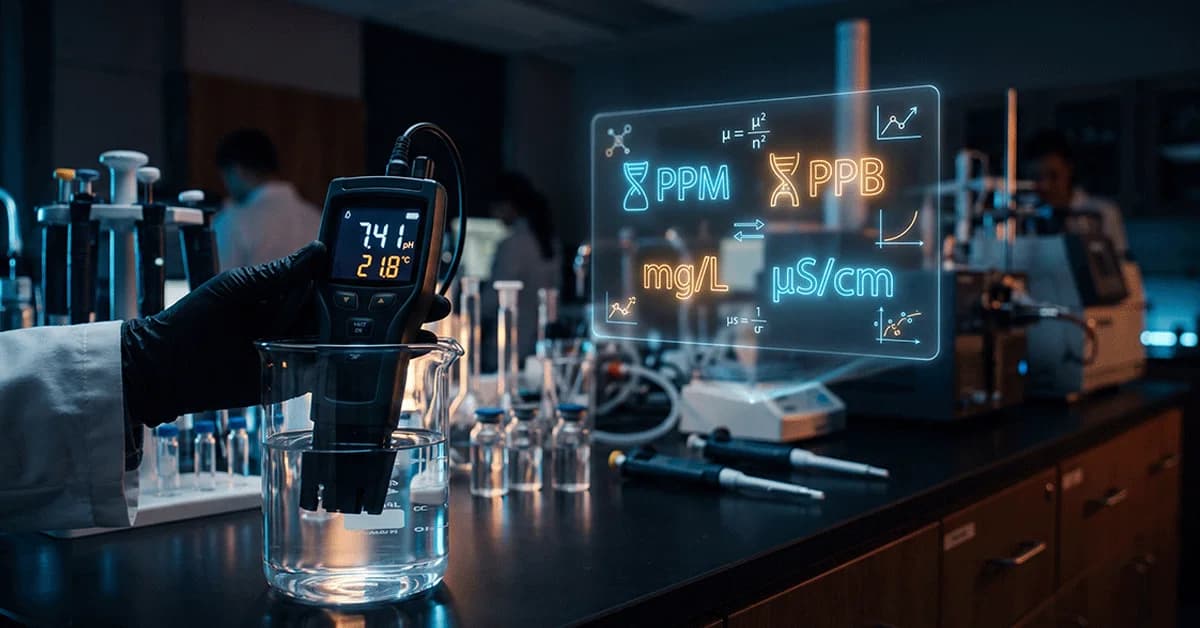
A PPM conversion chart is a standardized reference table used to instantly translate Parts Per Million (PPM) into other measurement units like percent, mass (mg/L), volume (PPMv), or water hardness.
Translating concentration values accurately requires different formulas depending on whether you are measuring liquids, gases, or solid mixtures.
When I first started managing water chemistry, the sheer number of conversion factors completely overwhelmed me. I would constantly switch from testing hydroponic nutrients to indoor air quality, only to realize the math rules changed entirely.
You can bookmark this page as your go-to chart for every common PPM-related conversion. For step-by-step calculations, I have linked my highly accurate calculators directly within each table row.
How Do I Use This PPM Conversion Chart for Concentration Units?
In my experience, the absolute most common conversions involve moving between straightforward ratios: Percent, PPM, PPB (Parts Per Billion), and PPT (Parts Per Trillion). These are straight dimensionless ratio conversions. This means they are the easiest to calculate because they do not depend on what physical substance you are measuring or its density.
Think of it like slicing a pie. Whether the pie is made of apple or cherry, one percent is always one out of a hundred slices. In the same way, 1 PPM is always one out of a million parts. When I need to quickly scale these numbers up or down, I rely on the conversion chart below.
| From Unit | To Unit | Multiply By | Calculator Link |
|---|---|---|---|
| Percent (%) | PPM | 10,000 | Percent to PPM → |
| PPM | Percent (%) | 0.0001 | PPM to Percent → |
| PPM | PPB | 1,000 | PPM to PPB → |
| PPB | PPM | 0.001 | PPB to PPM → |
| PPM | PPT | 1,000,000 | PPT to PPM → |
Converting basic concentration units is a simple matter of moving the decimal point. You multiply percent by 10,000 to get PPM, and you multiply PPM by 1,000 to get PPB.
What Are the Rules for Mass-Based Conversions (Liquids and Solids)?
When I deal with liquids or solids in a laboratory setting, I frequently need to convert physical weights (like grams or milligrams) into PPM. The critical rule I always remember is that for dilute aqueous solutions (like fresh tap water or pool water), 1 mg/L is exactly equal to 1 PPM. This is because one liter of fresh water weighs exactly one million milligrams.
However, if I am working with dense liquids (like heavy saltwater, syrups, or industrial solvents) or solid mixtures (like soil samples), that 1:1 rule goes out the window. I must know the exact total mass of the solution to find the correct ratio. For instance, if you are converting grams to ppm, you divide the mass of the solute by the total mass of the solution and multiply by one million.
| From Unit | To Unit | Conversion Rules & Notes | Calculator Link |
|---|---|---|---|
| Grams | PPM | Divide solute mass by total mass, multiply by 10⁶ | Grams to PPM → |
| PPM | Grams | Requires total solution mass to determine physical weight | PPM to Grams → |
| mg/L | PPM | 1:1 ratio strictly for dilute fresh water solutions only | mg/L to PPM → |
| Weight % (w/w) | PPM | Multiply the weight percentage by 10,000 | Weight % to PPM → |
For fresh water, 1 mg/L equals 1 PPM. For all other mixtures, you must divide the solute mass by the total solution mass and multiply by one million to find the exact PPM concentration.
How Does PPM Differ When Measuring Gases and Air Quality?
Whenever I switch from testing water chemistry to measuring indoor air quality (like CO2 monitoring) or industrial gas emissions, the math rules completely change. In the atmosphere, we use PPMv (Parts Per Million by volume) or mg/m³ (milligrams per cubic meter).
Because gases naturally expand and contract based on their environment, I have to account for the specific molecular weight of the gas, as well as the ambient temperature and atmospheric pressure. You cannot simply use a 1:1 ratio. This is where a dedicated ppmv to ppm calculator becomes essential, as it automatically applies the Ideal Gas Law to ensure your atmospheric readings are perfectly accurate.
| From Unit | To Unit | Conversion Rules & Notes | Calculator Link |
|---|---|---|---|
| PPM (mass) | PPMv (volume) | Requires Ideal Gas Law + precise gas molecular weight | PPM to PPMv → |
| PPMv (volume) | PPM (mass) | Convert volume fraction to mass fraction using molecular weight | PPMv to PPM → |
| mg/m³ | PPM | Standard conditions typically assume 25°C and 1 atm pressure | mg/m³ to PPM → |
Air quality conversions require you to use the Ideal Gas Law. To safely translate between mg/m³ and PPM for any hazardous gas, you must factor in the specific molecular weight of that gas at standard temperature and pressure parameters.
How Do I Convert Common Water Quality Metrics to PPM?
Water quality testing introduces a whole new set of scales that can be highly confusing. When I test for general water hardness, I often see lab results presented in Grains Per Gallon (GPG) or German Hardness (°dH). Converting these disparate metrics to a standardized PPM makes it infinitely easier for me to dose balancing chemicals accurately.
Other metrics require empirical estimations rather than pure math. For example, many treatment facilities search for an ntu to ppm conversion formula. NTU measures the cloudiness of water via light scatter, while PPM measures the physical mass of total suspended solids (TSS). You cannot convert them flawlessly, but you can estimate them. Similarly, utilizing an orp mv to ppm calculator requires understanding that ORP measures the *activity* of a sanitizer, not just the raw mass of chlorine present in the basin.
| From Unit | To Unit | Multiplier / Notes | Calculator Link |
|---|---|---|---|
| GPG (Grains/Gallon) | PPM | Multiply reading by 17.118 | GPG to PPM → |
| °dH (German) | PPM | Multiply reading by 17.848 | PPM to Hardness → |
| EC (µS/cm) | PPM (TDS) | Requires a specific conversion factor (usually 0.5 to 0.7) | EC to TDS PPM → |
| ORP (mV) | PPM (Chlorine) | Estimates free chlorine; highly dependent on pH and CYA | ORP to Chlorine → |
Water quality metrics often use specific multipliers to reach a standardized PPM. For example, multiply GPG by 17.118 to get PPM, and multiply German Hardness (°dH) by 17.848. However, advanced metrics like ORP and NTU require estimation curves rather than fixed multipliers.
Can I Convert PPM to Chemistry and Statistical Metrics?
In a professional laboratory or high-volume manufacturing setting, PPM is utilized entirely differently. Sometimes I need to execute a complex PPM to Molarity conversion to fully understand chemical reactions at a molecular scale. This requires knowing the exact molar mass of the compound in question.
Other times, working alongside Six Sigma manufacturing teams, I use PPM to track production defect rates per million opportunities. This ties directly into calculating the CPK (Process Capability Index) or DPMO (Defects Per Million Opportunities). These are statistical evaluations of manufacturing quality, far removed from the water testing origins of the unit.
| From Unit | To Unit | Conversion Rules & Notes | Calculator Link |
|---|---|---|---|
| PPM | Molarity (M) | Requires exact molar mass of the substance | PPM to Molarity → |
| Molarity (M) | PPM | Multiply molarity by molar mass, then by 1,000 | Molarity to PPM → |
| PPM | CPK | Calculates statistical defect rate against process bounds | PPM to CPK → |
| DPMO | Six Sigma Scale | Standardizes defects across varied production opportunities | DPMO Calculator → |
PPM can seamlessly translate into chemical molarity using specific molar mass, or it can represent strict statistical defect rates in Six Sigma processes to actively determine your CPK capability score.
Frequently Asked Questions
Why isn't there one universal PPM conversion factor?
There is no single universal multiplier because PPM is a relative ratio, not a fixed physical unit. In my real-life experience, 10 PPM of lead in drinking water is measured by mass (milligrams per liter), while 10 PPM of carbon monoxide in warehouse air is measured by volume (PPMv). Because gases, liquids, and solid compounds behave fundamentally differently based on temperature and pressure, I must use different math formulas to find the true concentration.
How do I convert NTU to PPM or mg/L?
You cannot perform a direct mathematical NTU to PPM conversion because NTU measures light scatter (turbidity) while PPM measures actual physical mass. However, for domestic wastewater management, engineers routinely estimate that 1 NTU roughly equals 1 to 1.5 PPM of Total Suspended Solids (TSS). You must use a calibrated ntu to mg/l calculator based on your specific water sample to get a safe, exact mass measurement.
Can I use an ORP to PPM calculator for chlorine?
Yes, you can, but with significant caveats. An ORP mv to chlorine ppm calculator estimates your free chlorine levels based strictly on the current oxidation potential and pH of the water. However, if your swimming pool has high Cyanuric Acid (CYA), the ORP reading will drop significantly even if the physical chlorine PPM remains consistently high. Remember, ORP measures chemical activity, while PPM measures physical mass.
How do I convert PPM to mL?
To convert a PPM concentration into milliliters (mL) of a liquid chemical, you must know the total volume of your solution and the density of the solute. PPM is a mass ratio (like mg/L). You first convert the PPM into milligrams based on your total water volume, and then divide by the density of the chemical (in mg/mL) to find the exact dosing volume in milliliters.
Which calculator should I use if I am not sure about my units?
Start by identifying whether you are testing a liquid, an atmospheric gas, or a solid sample. If I am testing swimming pool water or hydroponic reservoirs, I go straight to the mass-based or water quality calculators. If you are still confused, I highly recommend reading my introductory guide on What Is PPM first to completely confirm what type of concentration you are dealing with before attempting any advanced math.